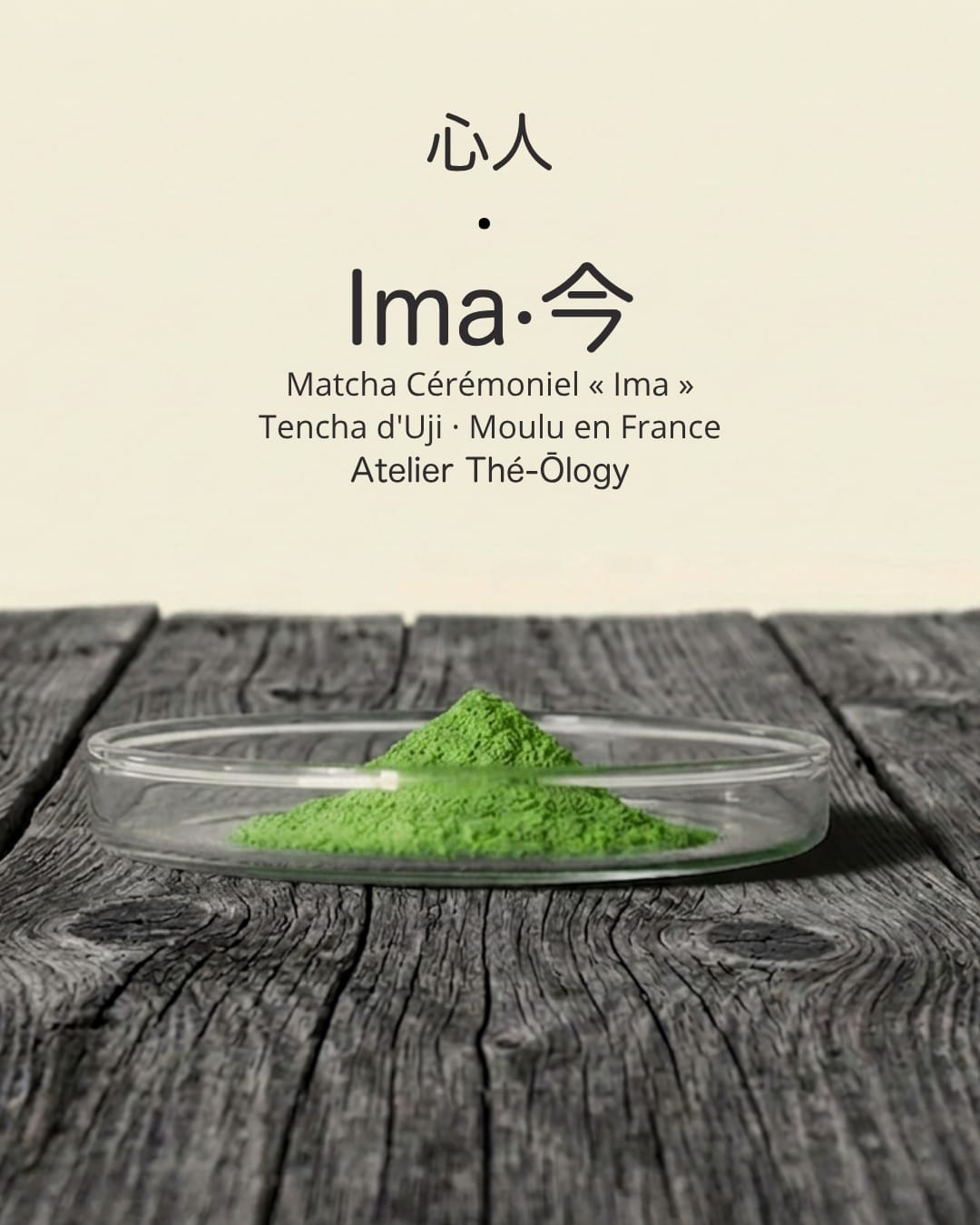
I believe a matcha should never die before it reaches your bowl. That's why I created this standalone reference in my selection: here, no pre-ground powder, but whole Uji Tencha leaves imported away from air, which I grind myself to order in my atelier in France, on a black granite mill — the only way to guarantee intact aromatic freshness and colour, impossible to achieve with ready-ground powder. The result: a powder of vivid jade green, without any bitterness.
Deep vegetal Intense umami Nori seaweed Creamy roundness
TEMP60-70°CTemperature
TIME20 secWhisking
DOSE2 gPer bowl
CAFFEINEModerateLevel
€3.70 per bowl · €1,850/kg · Ground to order in France
💡 For comparison: a specialty coffee costs on average €4 to €6 per cup. This ceremonial matcha costs €3.70 per bowl, with a stable energy and focus effect lasting up to 4× longer, thanks to L-theanine.
Matcha ground in my atelier Each batch is slowly ground on a black granite mill in Nice, in numbered micro-batches. Once a batch is gone, it's gone for good.
Ground to order Shipped within 48h of grinding for maximum freshness guaranteed on arrival.
Free shipping From €49 of purchase across mainland France.
CompositionThe Uji Terroir and Shading
This green tea powder is not a standardised blend. It's a strict selection of Tencha from a 4th-generation partner producer based in Uji (Kyoto).
The Development of Umami
The tea plants are placed under shade nets blocking direct light for a minimum of 30 days before harvest. This deprivation forces the plant to produce a significant amount of chlorophyll and L-theanine for its survival.
The Aromatic Profile
Extracting this powder reveals a dense liquor, free of bitterness. The vegetal top notes evoke nori seaweed, supported by a particularly creamy mouthfeel.
CraftsmanshipMy Artisanal Stone Grinding
Green tea powder is extremely vulnerable to oxidation. The long sea transit in containers affects its freshness. That's why I exclusively import the whole raw leaves to ensure the final processing happens locally.
This black granite mill took me a long time to find — I won't say who makes it, or where I unearthed it. What I can say is that I'm one of the few artisans in Europe working with this tool daily, and the difference is audible from the very first bowl: a finer grain, almost no friction heat, a deeper green.
Who Is This Matcha For?
-
First discovery: You want to experience the true taste of a Japanese matcha — pure, without astringency. This 20g format is designed for a gradual introduction to the traditional ritual.
-
Regular drinker: You already drink matcha but notice an olive-green colour or slight bitterness. Grinding to order eliminates the oxidation responsible for these flaws.
-
Discerning connoisseur: You demand full traceability — origin, producer, grinding date — and the strict use of a traditional natural stone mill.
Uji OriginGround in FranceCeremonial Grade
DetailsFull Identity
Name
Ceremonial Uji Matcha (Ground in France on a Black Granite Mill)
Type
Ultra-fine shade-grown green tea powder (Tencha)
Origin
Uji, Kyoto Prefecture (Japan)
Composition
100% Uji Tencha, shaded for a minimum of 30 days
Caffeine
Moderate (stabilised by L-theanine for a prolonged effect without spikes)
Profile
Intense jade green, velvety texture, deep umami, no bitterness
Format
Available from 20g to 500g — 10 to 250 bowls depending on the format chosen
Best Time
In the morning or before an intense work session, meditation or exercise
Storage
In its opaque, airtight tin, kept in the refrigerator
TipsMy Whisking Protocol
The Classic Preparation (Usucha)
I recommend sifting 2 grams of powder into your chawan (bowl). Pour 70 ml of water heated strictly to 60-70°C. Use a bamboo whisk (chasen) and whisk briskly in an "M" or "W" motion for 20 seconds, until you get a fine jade foam.
The Concentrated Experience (Koicha)
-
Dense liquor: Double the dose (4 grams) for just 40 ml of water at 60-70°C. Don't try to produce foam — instead, slowly knead the preparation. The result resembles a very high-intensity plant nectar.
Water temperature determines the balance of umami. Water at 60-70°C fully preserves the L-theanine responsible for sweetness. Above 80°C, tannin bitterness takes over and compromises the experience.
Interactive Timer
Follow the ideal 20-second whisking time with our online timer.
FAQFrequently Asked Questions
Origin Why grind the matcha leaves in France?
Green tea powder oxidises very quickly on contact with air. By importing the whole leaf (Tencha) and grinding it to order in my atelier, I guarantee intact aromatic freshness and colour.
Tool What is a black granite mill?
It's a traditional Japanese mill, carved from a rare black granite. Its extremely slow rotation (around 30 grams per hour) grinds the leaves into an ultra-fine powder without generating heat, thus preserving the chlorophyll.
Temperature Why shouldn't the water temperature exceed 70°C?
Water that's too hot instantly destroys L-theanine, the amino acid responsible for sweetness in the cup, while brutally releasing the tannins that cause the tea's bitterness.
Storage How do I store my matcha?
It's essential to keep the powder in its opaque, airtight tin, placed in the refrigerator. Remember to take it out fifteen minutes before preparation to avoid thermal shock and condensation.
Julien Salut — Artisan and Founder of THÉ.ŌLOGY A rigorous selection of specialty teas, carefully sourced and prepared. Find our tea house and Kintsugi atelier soon on the French Riviera (Nice).