Kintsugi Tool Making Guide – Bamboo & Wood – Vol. 1
Detailed instructions for making your own traditional kintsugi tools: bamboo hera spatulas, joban board, funzutsu tube. Standard Japanese dimensions, techniques tested in the atelier since 2016.
Couldn't load pickup availability
- Paiement sécurisé
- Téléchargement immédiat
- Fichier PDF, à lire et à imprimer
This guide allows you to make your own traditional kintsugi tools according to Japanese standards. Bamboo hera spatulas, wooden joban board, funzutsu tube with calibrated sieve. Detailed instructions, 60 workshop photographs, precise dimensions. For beginners and regular practitioners seeking autonomy in their practice.
Tools you will make
Techniques Guide features
Content Guide structure
Traditional tools covered
- Bamboo hera spatulas: 15 detailed pages with precise calibration from 1 to 2 mm thickness, cutting, sanding, and heat bending techniques
- Hinoki wood spatulas: 8 pages on selecting Japanese cypress, shaping, and treatment for urushi mixtures
- Joban board: 10 pages with standard Japanese dimensions (210 × 160 mm), wood selection, assembly, and finishing
- Funzutsu tube: 12 pages to make a bamboo powder sifter with calibrated sieve and beveled tip
- Traditional brushes: Section on making custom handles adapted to your grip
Practical sections included
The guide includes technical boxes on common errors (splitting bamboo, warped joban, clogged funzutsu), validation checklists after each tool, a tool journal template to document your progress, a complete glossary of Japanese terms, and a list of French and European suppliers (bamboo groves, wood, tools).
Estimated Manufacturing Time
- First hera spatula: 2 to 3 hours (including learning)
- Following spatulas: 45 minutes to 1 hour each
- Professional joban: 2 hours
- Complete funzutsu: 1 hour 30 minutes
- Complete tool set: 8 to 12 hours spread over 3 to 4 weeks
Materials Materials & Suppliers
Necessary Materials
To make all the tools, you will need bamboo rods of different diameters (available in bamboo groves), hardwood boards without resin for the joban (beech, maple, or ash as alternatives to Japanese magnolia), cypress or cedar wood for hinoki spatulas, and a fine metal sieve for the funzutsu. The guide details European equivalents to traditional Japanese woods.
Basic Tools Required
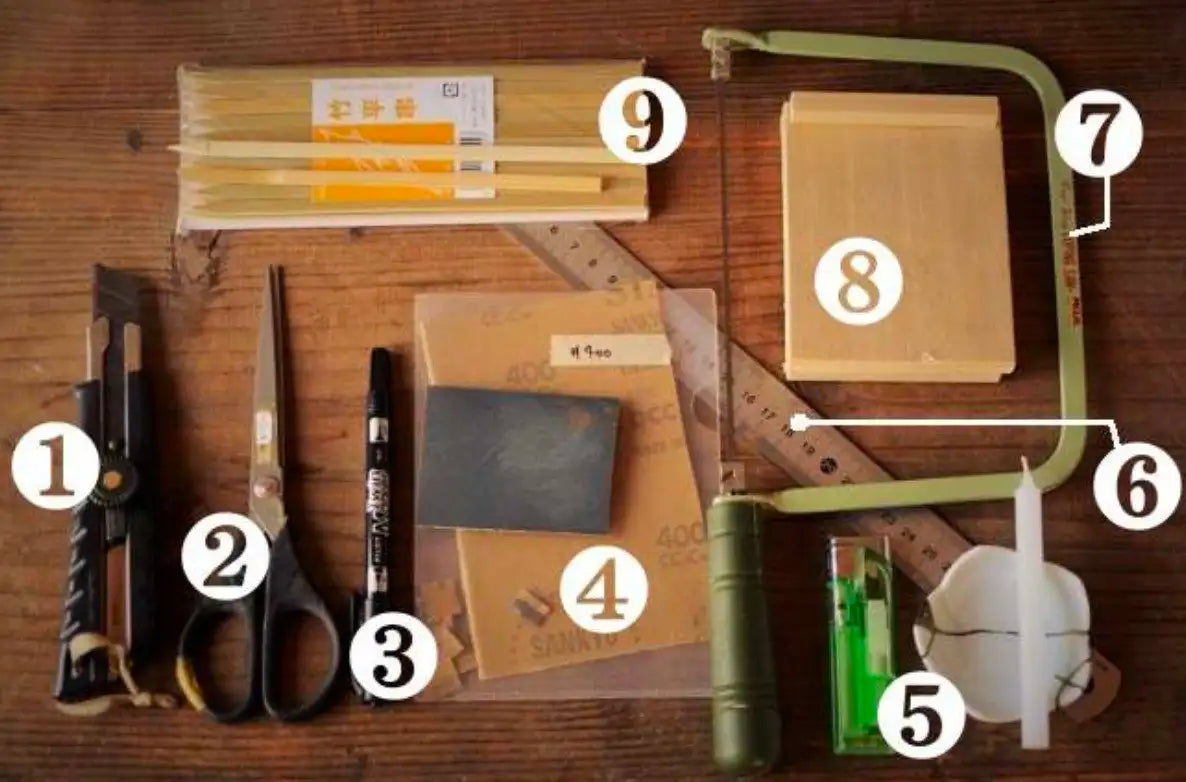
The necessary tools remain accessible: hand saw or Japanese saw, sharp knife or cutter, sandpapers from grit 120 to 600, drill with suitable bits, and a gentle heat source to bend bamboo. Tool budget estimated between 30 and 50 euros if starting from scratch. Everything is available at standard hardware stores.
Supply Sources
The guide lists 10 French and European sources: local bamboo groves for fresh bamboo, regional sawmills for hardwoods, online suppliers specialized in Japanese wood, and recovery alternatives (handles of old hardwood tools). Each source is commented on with selection criteria and price ranges.
Audience For Whom & Why
Kintsugi Beginners
If you are discovering the practice of kintsugi and want to understand the basics without immediately investing in expensive artisanal tools (150 to 400 euros for a complete set), this guide allows you to start with functional tools that you will have made yourself. No prior woodworking experience is required.
Regular Practitioners
For those who already practice and are looking for tools perfectly suited to their personal technique, the guide offers the possibility to precisely calibrate the thickness of spatulas, the curvature of tips, and dimensions according to your specific needs. You gain autonomy and reduce your dependence on Japanese suppliers.
Artisans in Professional Development
If you develop a kintsugi activity (workshops, repairs, training), making your own tools becomes an economic advantage and allows you to offer this skill in your workshops. Tool making workshops cost between 300 and 500 euros for two days in France. This guide offers total autonomy for a one-time investment.
Comparative value
- Tool making workshop (2 days): 300 to 960 euros depending on the organization
- Set of Japanese handcrafted tools (purchase): 150 to 400 euros
- Set of 3 handcrafted bamboo spatulas: 30 to 50 euros
- This complete guide: 79 euros with unlimited access and repeated making
Bonus Additional Included Resources
Patterns and templates
The guide includes reusable patterns with exact dimensions for each tool, ready to print and transfer onto your materials. Hera spatula templates are provided in three thicknesses (1 mm, 1.5 mm, 2 mm) to adapt according to your needs.
Validation tools
Each section includes quality validation checklists (flexibility test for spatulas, flatness of the joban, calibration of the funzutsu sieve) and detailed solutions to the 12 most common manufacturing problems.
Organization and tracking
A dedicated module for organizing your workshop optimizes the workspace. The downloadable tool journal template allows you to document each creation with photos, dimensions, adjustments, and feedback. A suggested 4-week production calendar structures your progressive learning.
Maintenance and durability
The complete maintenance guide covers cleaning after use (urushi, sabi), optimal storage (moisture protection), and repair techniques for damaged tools. Well-maintained bamboo spatulas retain their properties for several years of intensive use.
FAQ Frequently Asked Questions
Tools Do I need special tools to start?
No, basic tools are enough. You will need a handsaw, a sharp knife or sturdy cutter, sandpapers from grit 120 to 600, a drill with wood bits, and a gentle heat source (tea light candle or stove). Everything is available at hardware stores for a budget of 30 to 50 euros if you start from scratch. The guide details alternatives and tips to reduce costs without compromising the quality of the tools made.
Sourcing Where to find the necessary bamboo and wood?
The guide lists more than 10 verified French and European sources. For bamboo, you can contact local bamboo groves (Prafrance in Occitanie, Bambou Diffusion in Brittany), specialized online suppliers, or collect ornamental bamboo canes. For hardwoods (beech, maple, ash), regional sawmills offer offcuts at reduced prices. Cypress and cedar for hinoki spatulas are available from Japanese wood dealers or model-making stores. European alternatives and detailed selection criteria are provided in the resource appendix.
Time How long before I have my first functional tool?
Your first functional hera spatula will be ready in 2 to 3 hours, including learning. This time includes selecting the bamboo, cutting, shaping, progressive sanding, and heat bending. From the second spatula onward, the time drops to 45 minutes to 1 hour thanks to gained experience. The joban takes about 2 hours and the funzutsu 1 hour 30. A weekend is enough to make your first essential tools. The full set can be completed over 3 to 4 weeks with a few hours per week.
Level Is the guide suitable for absolute beginners?
Yes, the guide is designed to be accessible without prior experience in woodworking or kintsugi. Each step is photographed and described in detail with clear vocabulary. Sections include boxes on common mistakes to avoid and technical gestures to master. Dimensions are given to the nearest millimeter, angles are illustrated, and validation techniques allow you to check quality at each step. If you know how to use a saw and sandpaper, you can follow this guide.
Commercial Can I use these techniques to teach?
The guide is intended for personal use only. You can make as many tools as you want for your own kintsugi practice. However, commercial use of the content (reproduction, training workshops based on this guide, resale of the PDF) is not allowed under the personal use license. If you want to incorporate these techniques into a professional activity (paid workshops, training), contact contact@the-ology.fr to discuss a suitable professional license.
Updates Are there any updates planned?
Yes, guide updates are free for life for all buyers. Future updates will include new manufacturing techniques based on feedback, additional photographs upon community request, sheets on new traditional tools (specific brushes, drying supports), and an expanded supplier list as availability allows. You will receive an email notification with a download link for each major update. Your PDF file remains accessible indefinitely.
Format How to receive and use the guide after purchase?
After secure payment validation, you immediately receive an email containing the PDF download link. The file is compatible with all devices (Windows/Mac computer, iPad/Android tablet, smartphone). You can view it offline once downloaded. Printing is allowed for personal use only. The PDF file contains a discreet identifier linked to your purchase to protect intellectual property. Keep your download link to access future free updates.
Guarantees Security & Conditions
Payment and Delivery
Payment is secured via Stripe and PayPal with 3D Secure protection. After validation, you immediately receive an email with the permanent download link. No waiting time, access 24/7. The PDF file remains accessible indefinitely from your client area.
Data Protection
Your personal data is protected in accordance with GDPR. The PDF document contains a discreet identifier linked to your buyer account for traceability in case of piracy. This measure protects the author's work without affecting your normal personal use.
Intellectual Property
Copyright protected 2026 Julien Salut – All rights reserved. Personal use authorized. Reproduction, distribution, or commercial use prohibited without written permission. The techniques described come from 5 years of daily practice in the workshop and research on traditional Japanese methods.
Satisfaction or Refund Guarantee
If the guide does not meet your expectations within 14 days of purchase, contact contact@the-ology.fr with your order number for a full refund. This guarantee reflects confidence in the quality and usefulness of the content provided.
Share